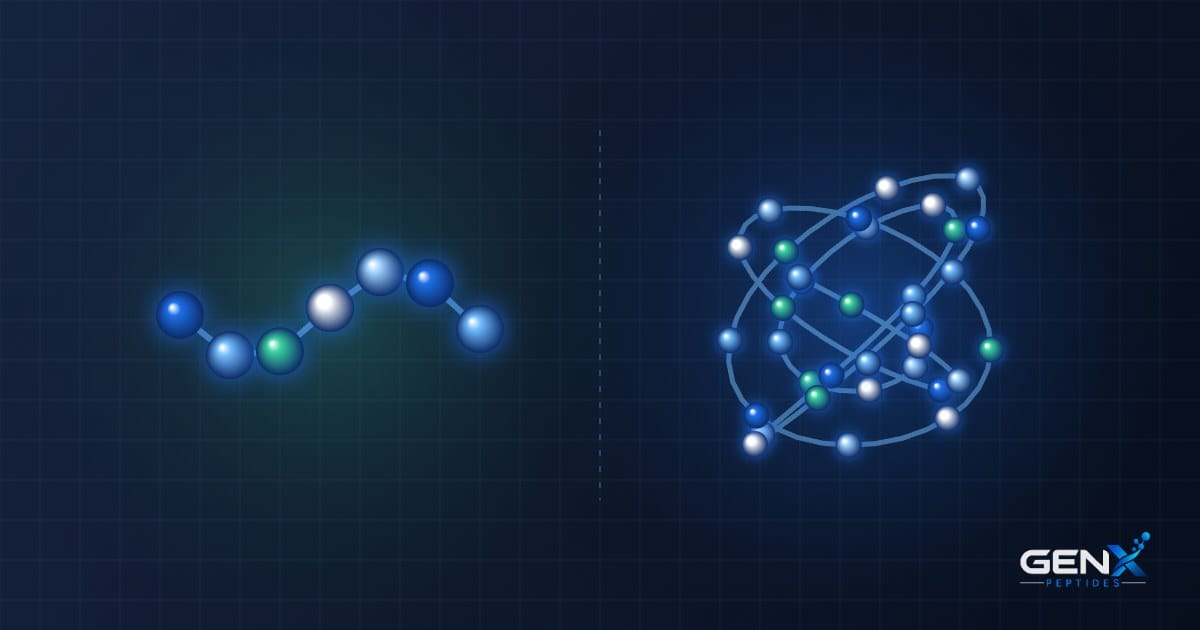
Peptides and proteins are made of the same building blocks, joined by the same chemical bond. So where does one end and the other begin? The short answer is size, but the more useful answer involves structure and function too. This guide explains the key differences in plain language.
The hierarchy at a glance
It helps to picture the terms as steps on a ladder, from smallest to largest:
- Amino acid: a single building block.
- Peptide: a short string of amino acids linked together.
- Polypeptide: a longer string, often dozens of amino acids, that may start to fold.
- Protein: one or more polypeptides folded into a stable shape that does a specific job.
The shared building blocks
Both peptides and proteins are chains of amino acids. Living things use 20 standard amino acids, each with the same backbone and a different side chain that gives it its own chemical personality: some are water-loving, some water-repelling, some carry a charge.
Every amino acid is built around the same three parts:
- An amino group (NH₂) at one end.
- A carboxyl group (COOH) at the other end.
- A side chain, often called the R group, which is different for each amino acid and decides how it behaves.
Amino acids link together through a peptide bond, a connection between the carboxyl group of one amino acid and the amino group of the next. String a few together and you have a peptide. Keep going for long enough and you have a protein.
Difference #1: Size
Size is the most common way to tell them apart, though there is no single official cutoff:
| Peptides | Proteins | |
|---|---|---|
| Typical length | About 2 to 50 amino acids | More than about 50 amino acids, often hundreds |
| Typical molecular weight | Under roughly 5,000 daltons | Often 10,000 to several hundred thousand daltons |
| Number of chains | Usually one | One or several chains working together |
Very short chains have their own names: two amino acids form a dipeptide, three a tripeptide, and chains of up to about 20 are often called oligopeptides. Longer chains are polypeptides, and a polypeptide that folds into a stable, working shape is generally called a protein.
Difference #2: Structure
Scientists describe the shape of these molecules in four levels:
- Primary structure: the order of amino acids in the chain. Every peptide and protein has one.
- Secondary structure: local patterns such as the alpha helix and the beta sheet, held together by hydrogen bonds along the backbone.
- Tertiary structure: the overall three-dimensional fold of a single chain.
- Quaternary structure: how several folded chains fit together into one larger unit.
Most proteins fold into a defined three-dimensional shape, and that shape is essential to how they work. Many short peptides are more flexible and may not hold a single fixed shape in solution, although some do form helices, turns or rings (cyclic peptides). Quaternary structure is a protein feature: hemoglobin, for example, is built from four separate chains.
Difference #3: Function
Because they are small, many peptides act as messengers that carry signals between cells. Proteins, with their larger and more complex shapes, more often act as the machinery and scaffolding of the cell.
| Role | Peptide examples | Protein examples |
|---|---|---|
| Signaling | Oxytocin (9 amino acids), peptide hormones | Growth factors and cytokines |
| Defense | Antimicrobial peptides | Antibodies |
| Protection inside cells | Glutathione (3 amino acids) | Heat-shock proteins |
| Catalysis | Rare | Enzymes such as amylase |
| Structure | Rare | Collagen, keratin, actin |
| Transport | Rare | Hemoglobin, membrane channels |
Insulin is a useful borderline case. With 51 amino acids in two chains, it is often called a peptide hormone, yet it is large enough that some sources call it a small protein. The line between the two categories is a convention, not a hard rule.
Difference #4: Stability and handling
Size and structure also affect how these molecules behave in the lab:
- Folding: a protein that loses its folded shape (denaturation) usually stops working, while many short peptides have little folded structure to lose.
- Sensitivity: both can be broken down by enzymes called proteases, and both are sensitive to heat, moisture and light over time.
- Storage: research peptides are commonly supplied as a dry, freeze-dried (lyophilized) powder, which keeps them stable much longer than they would be in solution.
For practical tips, see our guide on how to properly store and handle peptides.
Which term should you use?
Every protein is made of polypeptide chains, but not every polypeptide is a protein. A simple way to choose the right word:
- Use peptide for a short chain, roughly under 50 amino acids.
- Use protein for a long chain that folds into a defined shape and carries out a specific task.
Put another way: all proteins are amino acid chains, but only the long, folded, working ones earn the name protein.
Quick comparison
| Peptides | Proteins | |
|---|---|---|
| Building blocks | Amino acids | Amino acids |
| Bond type | Peptide bonds | Peptide bonds |
| Size | About 2 to 50 amino acids | More than about 50 amino acids |
| Shape | Often flexible; some form helices or rings | Usually a defined 3D fold |
| Common roles | Signaling, defense | Enzymes, structure, transport, signaling |
Frequently asked questions
Is every protein made of peptides?
In a sense, yes. A protein is one or more long polypeptide chains folded into a working shape, and every link in those chains is a peptide bond.
What is the cutoff between a peptide and a protein?
There is no official cutoff. About 50 amino acids is the most common rule of thumb, but you will see some sources use 40 or 100.
Is insulin a peptide or a protein?
Both labels are used. Insulin has 51 amino acids across two chains, right at the usual dividing line, so it is often called a peptide hormone.
Where can I learn more about research peptides?
Start with our guide What Are Research Peptides?, or browse the full Peptide Info library.
Research Use Only: All products sold by GenX Peptides™ are strictly for laboratory research. They are not for human or veterinary use and are not intended to diagnose, treat, cure or prevent any disease. This article is for educational purposes only.
 Install the GenX app